✦ TAROT · A VISUAL STUDY GUIDE
The 22 Major Arcanaone tarot card at a time.
A beginning. A choice. A turning point. Learn to recognise tarot’s larger themes through its images — and find a better question in every card.
01 / The basics
What are the Major Arcana in tarot?
The Major Arcana are the 22 tarot cards associated, in symbolic readings, with broad human themes: identity, choices, change, boundaries and growth. In the Rider–Waite–Smith deck, they run from The Fool (0) to The World (XXI). They form part of the 78-card tarot deck alongside the 56 Minor Arcana.
“Arcana” refers to secrets or mysteries. For study, think of each card as an image that opens a perspective on a situation. Its interpretation depends on the question, its position in a spread and the surrounding cards. A keyword helps you remember; it does not determine what will happen.
Major vs. Minor Arcana: what is the difference?
| Group | Structure | Reading focus |
|---|---|---|
| Major Arcana | 22 cards, from 0 to XXI | Broad themes, transitions and learning. |
| Minor Arcana | 56 cards across four suits | Everyday experiences, actions, feelings and resources. |
This guide follows Rider–Waite–Smith order: VIII is Strength and XI is Justice. The Tarot de Marseille reverses those two positions. The Fool may also be unnumbered. Check your deck’s tradition before comparing card numbers.
02 / RIDER–WAITE–SMITH
All 22 Major Arcana cards and their meanings
Choose a card to enlarge the artwork and open its study notes. Explore the image, central meaning, practical context and challenges of each card.
22 of 22 cards
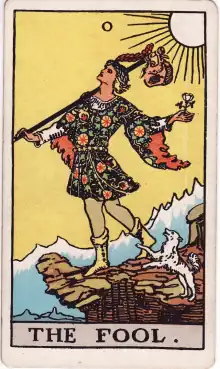
0The Fool
A beginning without a map. Openness to a first step.
Enlarge and explore ↗
Look at the image
A traveller stands at a cliff edge with a small bundle, a white rose and a dog at his feet.
The central meaning
A beginning without a map. Openness to a first step.
In practice
A new project, a journey or a change of direction can invite curiosity before certainty. Explore with a small, reversible experiment; enthusiasm works best alongside an honest look at the risks.
Challenges and reversals
Recklessness, avoiding responsibility or starting everything and finishing nothing. The opposite can also apply: fear of mistakes prevents any beginning.
A question to reflect on
What small first step could I try without demanding a complete plan?
 I
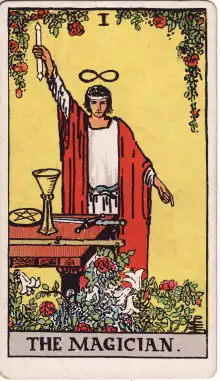
IThe Magician
Bring intention and available skills into action.
Enlarge and explore ↗
Look at the image
A figure stands at a table with a cup, sword, pentacle and wand. One hand points upward and the other downward.
The central meaning
Bring intention and available skills into action.
In practice
Look at what you already have: knowledge, time, tools and the ability to communicate. In work or relationships, this can mean making a clear proposal instead of waiting for perfect conditions.
Challenges and reversals
Persuasive words without substance, manipulation or the illusion of total control. It can also mean underestimating your abilities and never using them.
A question to reflect on
Which tool is already on my table, waiting to be used?
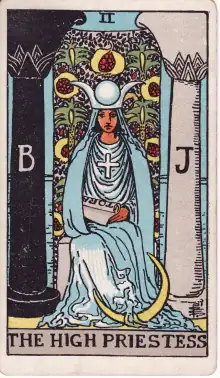
IIThe High Priestess
Quiet attention to what is not yet fully understood.
Enlarge and explore ↗
Look at the image
A seated woman holds a scroll between a dark and a light pillar, with a veil behind her and a crescent at her feet.
The central meaning
Quiet attention to what is not yet fully understood.
In practice
Take time to listen, study or put a feeling into words. Intuition can suggest a question to investigate; it does not establish facts about another person's secrets. Leave room for information that is still missing.
Challenges and reversals
Secrecy becoming isolation, dismissing your inner experience or reading so many signs that you lose contact with observable facts.
A question to reflect on
What am I noticing quietly, and what would help me check my interpretation?
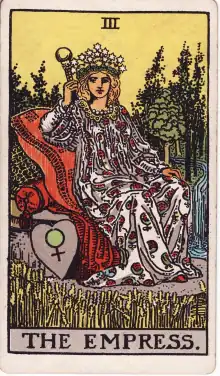 III
IIIThe Empress
Growth through care, creativity and nourishment.
Enlarge and explore ↗
Look at the image
A crowned woman sits among wheat and trees, beside a shield bearing the symbol of Venus.
The central meaning
Growth through care, creativity and nourishment.
In practice
A relationship, home or creative project may need regular attention rather than pressure for immediate results. Notice what supports enjoyment and sustainable growth. Fertility here is a creative symbol, not a pregnancy diagnosis.
Challenges and reversals
Overprotectiveness, excess or caring for everyone while neglecting yourself. Giving without boundaries can eventually leave little to give.
A question to reflect on
What might flourish if I offered it care instead of demanding a result today?
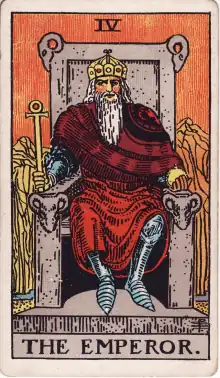 IV
IVThe Emperor
Structure, boundaries and responsibility.
Enlarge and explore ↗
Look at the image
A ruler sits on a stone throne decorated with ram heads; armour and mountains suggest firmness.
The central meaning
Structure, boundaries and responsibility.
In practice
Make a plan, clarify roles or protect time for what matters. Authority is useful when it makes expectations understandable. In a relationship, consider which agreements create security while respecting both people.
Challenges and reversals
Rigidity, domination or insisting that only one way is acceptable. At the other extreme, absent structure leaves responsibilities unclaimed.
A question to reflect on
Which clear boundary would protect what I am building?
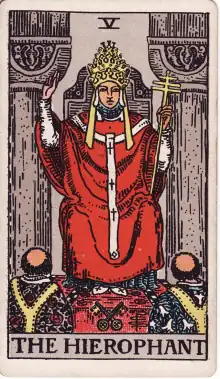 V
VThe Hierophant
Shared learning, tradition and examined values.
Enlarge and explore ↗
Look at the image
A religious teacher sits between pillars before two students; crossed keys lie near his feet.
The central meaning
Shared learning, tradition and examined values.
In practice
A teacher, established method or community can offer useful foundations. Consider what a commitment means to you, whether in study, work or a relationship. Learning from tradition need not mean surrendering your judgement.
Challenges and reversals
Dogma, conformity or following a rule simply because it is familiar. Rejecting every source of guidance can also make learning unnecessarily difficult.
A question to reflect on
Who or what could teach me something without replacing my own judgement?
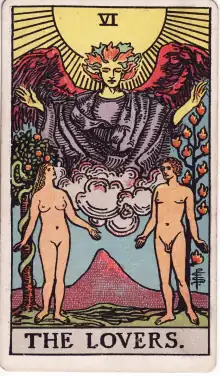 VI
VIThe Lovers
Connection and a choice aligned with your values.
Enlarge and explore ↗
Look at the image
Two unclothed figures stand beneath an angel, with trees behind them and a mountain between them.
The central meaning
Connection and a choice aligned with your values.
In practice
Romantic attraction is one possible context; the broader theme is commitment. Ask whether your desires, actions and values agree. Choosing a partnership or a direction usually means accepting the limits of that choice.
Challenges and reversals
Chronic indecision, pressure to please or chemistry that distracts from incompatible needs. Avoid treating this card as proof of a destined partner.
A question to reflect on
What would change if I chose according to my values rather than approval?
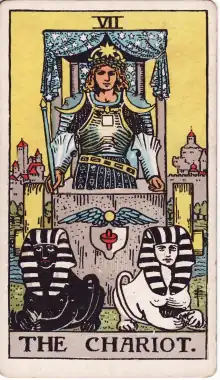 VII
VIIThe Chariot
Direction that coordinates competing forces.
Enlarge and explore ↗
Look at the image
An armoured figure stands in a chariot before a black and a white sphinx.
The central meaning
Direction that coordinates competing forces.
In practice
After choosing a goal, organise your effort. A practical reading might involve setting a route, defining priorities or bringing different motivations into agreement. Progress asks for coordination as well as determination.
Challenges and reversals
Aggressive haste, winning at any cost or moving without a meaningful destination. Conflicting priorities may also keep you stuck.
A question to reflect on
Where do I want to go, and which competing pull needs my attention?
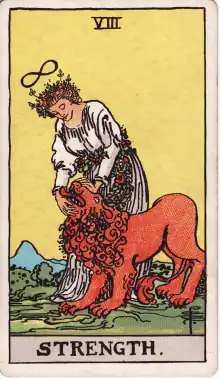 VIII
VIIIStrength
Courage expressed through patience and composure.
Enlarge and explore ↗
Look at the image
A woman gently holds a lion's jaws beneath an infinity symbol.
The central meaning
Courage expressed through patience and composure.
In practice
Firmness need not be harsh. In a difficult conversation or demanding project, notice an impulse before acting on it. This card offers a way to explore steady confidence rather than a promise that effort always wins.
Challenges and reversals
Force, stubbornness or suppressing every feeling. The opposite can be shrinking yourself because you mistake kindness for weakness.
A question to reflect on
Where could I be firm without becoming hard?
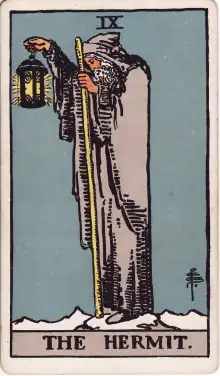 IX
IXThe Hermit
Step back to see more clearly.
Enlarge and explore ↗
Look at the image
An older figure stands alone with a staff and a lantern containing a six-pointed star.
The central meaning
Step back to see more clearly.
In practice
Quiet study, a walk or advice from someone experienced can help you hear your own reasoning. Solitude may be chosen and productive; it does not automatically signify rejection or a relationship ending.
Challenges and reversals
Withdrawal becoming avoidance, waiting for absolute certainty or filling every silence so that reflection never happens.
A question to reflect on
What becomes clearer when I turn down the noise for a while?
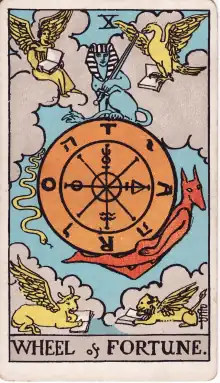 X
XWheel of Fortune
A changing cycle and a chance to adapt.
Enlarge and explore ↗
Look at the image
A wheel is surrounded by creatures and symbols; figures rise and descend around its rim.
The central meaning
A changing cycle and a chance to adapt.
In practice
Separate what you can influence from what depends on timing or circumstances. In work and relationships, a shift in conditions may call for flexibility. The card does not guarantee a windfall or erase your choices.
Challenges and reversals
Fatalism, repeating a familiar pattern or assuming that a high point must last forever. Trying to freeze every change can make adjustment harder.
A question to reflect on
What is changing, and what useful response is within my reach?
 XI
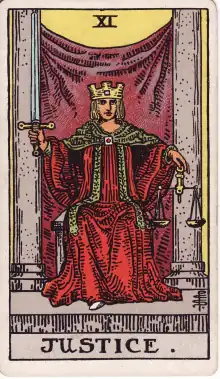
XIJustice
Fairness, evidence and responsibility for choices.
Enlarge and explore ↗
Look at the image
A seated figure holds an upright sword and balanced scales.
The central meaning
Fairness, evidence and responsibility for choices.
In practice
Review an agreement, check the facts or acknowledge your part in a situation. Fairness is a process of listening and weighing evidence. The card cannot establish the outcome of a legal case or another person's guilt.
Challenges and reversals
Harsh judgement, a double standard or avoiding accountability. A wish to be right can obscure the information needed for a fair decision.
A question to reflect on
Which fact would I need to acknowledge to judge this more fairly?
 XII
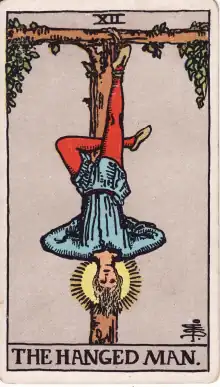
XIIThe Hanged Man
A pause that changes your perspective.
Enlarge and explore ↗
Look at the image
A calm figure hangs upside down by one foot, with a halo around his head.
The central meaning
A pause that changes your perspective.
In practice
If effort is getting nowhere, try changing the question or allowing time to gather information. Letting go of one approach may reveal another. A useful pause has a purpose; it does not require accepting harm.
Challenges and reversals
Indefinite postponement, unnecessary self-sacrifice or remaining stuck out of habit. Refusing any pause can be equally limiting.
A question to reflect on
What might become visible if I stopped pushing this particular approach?
 XIII
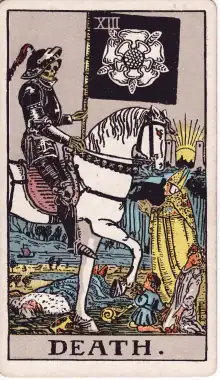
XIIIDeath
An ending that makes room for transformation.
Enlarge and explore ↗
Look at the image
An armoured skeleton rides a white horse carrying a black banner; the sun appears between distant towers.
The central meaning
An ending that makes room for transformation.
In practice
An old habit, role or phase may need to be acknowledged as finished. Explore what can be released and what deserves to continue in a different form. This card is not evidence or a prediction of physical death.
Challenges and reversals
Clinging to what has ended or destroying something impulsively before understanding it. Change need not become a demand to abandon everything.
A question to reflect on
What has changed beyond returning to exactly the way it was?
 XIV
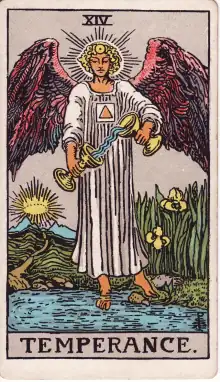
XIVTemperance
Integration through proportion and a sustainable pace.
Enlarge and explore ↗
Look at the image
An angel pours liquid between two cups, with one foot on land and the other in water.
The central meaning
Integration through proportion and a sustainable pace.
In practice
Bring different needs into conversation. A team, a routine or a relationship may benefit from small adjustments tested over time. Balance is active work, not a requirement to compromise on every principle.
Challenges and reversals
Avoiding a decision in the name of harmony, swinging between extremes or expecting gradual change to happen immediately.
A question to reflect on
Which two parts of my life need to cooperate rather than compete?
 XV
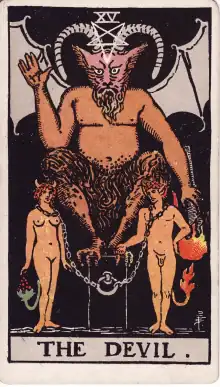
XVThe Devil
Notice attachment and the cost of a familiar pattern.
Enlarge and explore ↗
Look at the image
A horned figure sits above two people with loose chains around their necks.
The central meaning
Notice attachment and the cost of a familiar pattern.
In practice
Look at habits, incentives and situations in which choice feels constrained. Recognising a pattern can suggest where support is needed. The loose chains are a symbol; real dependency and coercion are not always simple to leave.
Challenges and reversals
Denial, compulsive repetition or shame that makes asking for help harder. The card does not prove a curse, possession or someone else's bad intentions.
A question to reflect on
What does this pattern give me, what does it cost, and what support might help?
 XVI
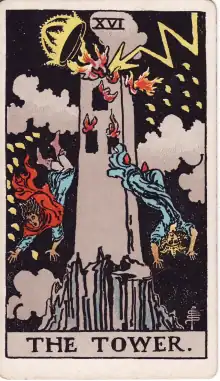
XVIThe Tower
A disruption that exposes an unstable structure.
Enlarge and explore ↗
Look at the image
Lightning strikes a tower, a crown is thrown off and two figures fall.
The central meaning
A disruption that exposes an unstable structure.
In practice
A surprising fact can challenge an assumption or plan. Begin with what is observable and consider what needs rebuilding. The image can name the feeling of disruption without predicting an accident or disaster.
Challenges and reversals
Ignoring warning signs, defending a failing assumption or creating conflict just to feel movement. Rebuilding may require a slower, steadier response.
A question to reflect on
Which assumption needs checking before I continue building on it?
 XVII
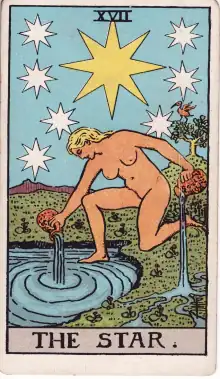
XVIIThe Star
Renewed hope and patient replenishment.
Enlarge and explore ↗
Look at the image
A kneeling figure pours water onto land and into a pool beneath one large star and seven smaller stars.
The central meaning
Renewed hope and patient replenishment.
In practice
After difficulty, make room for inspiration and small sources of encouragement. A creative project or connection may benefit from honest generosity. Hope supports action; it is not a guarantee that every difficulty is over.
Challenges and reversals
Idealism that overlooks unfinished work, discouragement or giving more than you can sustain. Restoring confidence can take time.
A question to reflect on
What still deserves my care and attention after a difficult period?
 XVIII
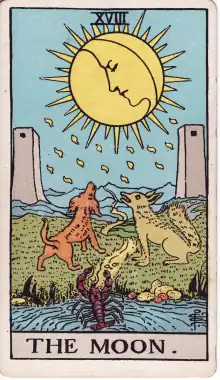
XVIIIThe Moon
Uncertainty, imagination and feelings below the surface.
Enlarge and explore ↗
Look at the image
A path runs between two towers; a dog and a wolf face the moon while a crayfish emerges from water.
The central meaning
Uncertainty, imagination and feelings below the surface.
In practice
Distinguish what you observed from what you fear or imagine. Dreams can be material for reflection, but they do not confirm deception. Give an unclear question time and seek information before drawing a conclusion.
Challenges and reversals
Confusion, self-deception or treating every fear as evidence. Demanding instant certainty can also lead to premature answers.
A question to reflect on
What do I know, what am I imagining, and what remains uncertain?
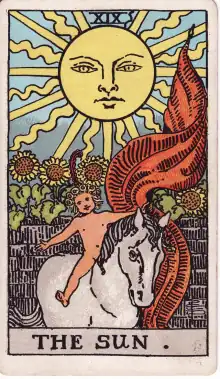
XIXThe Sun
Clarity, warmth and shared enjoyment.
Enlarge and explore ↗
Look at the image
A child rides a white horse before sunflowers beneath a radiant sun.
The central meaning
Clarity, warmth and shared enjoyment.
In practice
Recognise what is working and communicate it plainly. Celebrate progress, enjoy a connection or show a creative result. This is an invitation to notice available joy, not a promise of perfect circumstances.
Challenges and reversals
Overconfidence, seeking applause or overlooking details because things feel positive. It can also be difficulty receiving a good experience.
A question to reflect on
What is already clear and worthwhile enough for me to enjoy today?
 XX
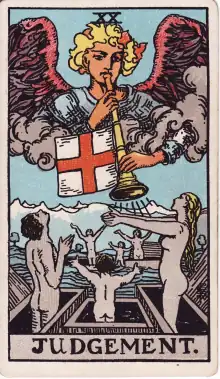
XXJudgement
Review your experience and respond to a new understanding.
Enlarge and explore ↗
Look at the image
An angel sounds a trumpet while people rise from open tombs with their arms raised.
The central meaning
Review your experience and respond to a new understanding.
In practice
Look back to identify what you have learned and what deserves a different response now. A change of direction may begin with accountability and self-forgiveness. Renewal does not automatically mean an ex-partner will return.
Challenges and reversals
Relentless self-criticism, avoiding reflection or postponing a choice you are ready to consider. Review should help you act, not trap you in the past.
A question to reflect on
What have I learned that asks for a different response now?
 XXI
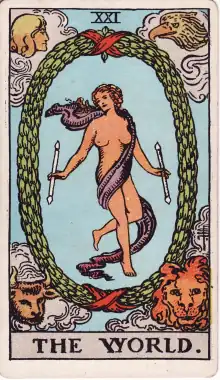
XXIThe World
Completion, integration and a sense of belonging.
Enlarge and explore ↗
Look at the image
A dancing figure appears inside a wreath, with four symbolic beings in the corners.
The central meaning
Completion, integration and a sense of belonging.
In practice
Recognise a finished stage, bring loose ends together and acknowledge the work involved. A completed project or learning cycle creates space for a new beginning; completion need not mean that everything is perfect.
Challenges and reversals
Perfectionism that prevents finishing, leaving the last step undone or rushing into the next goal before recognising this one.
A question to reflect on
What is complete enough for me to acknowledge and bring to a close?
No cards found. Try another name, number or theme.
Art by Pamela Colman Smith · Rider–Waite–Smith · References
03 / The journey
The Fool’s Journey: a way to learn the Major Arcana
Imagine The Fool meeting each card as a learning experience. This three-part division is a teaching tool, not a required sequence of life events or a proven historical origin of tarot.
Discover the world
From The Fool to The Chariot: initiative, listening, care, structure, learning, choice and direction. Explore the encounter between your identity and the world around you.
Grow from within
From Strength to Temperance: patience, solitude, cycles, responsibility, pause and transformation. Progress does not always look like movement.
Integrate experience
From The Devil to The World: recognise attachments, question structures, renew hope, navigate uncertainty, find clarity and complete a stage.
04 / How to read
How to read the Major Arcana without memorising everything
Begin with one card and an open question. Studying means connecting image and context instead of expecting an automatic answer.
Look before consulting a guide
Observe for a minute. Note three visible elements: a gesture, an object and a relationship between figures. Separate what the scene shows from what you imagine about it.
Read the meaning and compare
Return to the image after reading. Pick one symbol that helps you remember the theme. Strength’s gentle contact with the lion, for example, can suggest firmness without aggression.
Return to the question and position
The same card serves a different purpose in each position: “situation” offers a perspective, “challenge” names a tension, and “next step” invites a possible response.
Record and revisit
Write one interpretation, one uncertainty and one small action. When you revisit your journal, include what did not fit. That helps you avoid treating every outcome as confirmation.
A reversed card does not automatically mean something bad
Reading reversals is a choice of method. You can explore a blockage, an excess, a difficulty or a more inward expression of the theme. You can also study upright cards only. Decide before the reading and consider the context. These study notes present challenges as possibilities for reflection, not punishments or universal definitions.
Frequently asked questions about the Major Arcana
What are the 22 Major Arcana in order?
The Fool, The Magician, The High Priestess, The Empress, The Emperor, The Hierophant, The Lovers, The Chariot, Strength, The Hermit, Wheel of Fortune, Justice, The Hanged Man, Death, Temperance, The Devil, The Tower, The Star, The Moon, The Sun, Judgement and The World. This is Rider–Waite–Smith order.
Can I read tarot with only the 22 Major Arcana?
Yes. A single card or a three-card spread can help you study broad themes. Set the question and positions before revealing the cards. The Minor Arcana expand the vocabulary of a reading but are not required for this exercise.
Does the Death card mean physical death?
It is not a prediction of physical death. In this guide, Death symbolises endings, letting go and transformation. No card can diagnose illness or determine how long someone will live.
Does The Lovers mean I will find love?
You can explore this card in a romantic context, but its themes also include choice and values. It does not confirm mutual attraction, another person’s thoughts or a guaranteed new relationship.
Why is Strength VIII in one deck and XI in another?
Different traditions use different orders. In Rider–Waite–Smith, Strength is VIII and Justice is XI. In the Tarot de Marseille, Justice is VIII and Strength is XI. Use the name and image to identify the card.
What does it mean to draw several Major Arcana cards?
Some methods treat this as an invitation to consider broader themes. The deck’s composition and the number of cards drawn also affect how many appear. Several Major Arcana do not prove that an extraordinary event will occur.
Do I need to memorise every meaning?
No. Start with one card each day or week. Observe, read, connect it to a question and write one sentence. Return to this gallery whenever you want to compare cards.
References and editorial notes
An educational adaptation of Oraculum’s “Os 22 Arcanos Maiores do Tarot” study guide. Practical interpretations and questions are contemporary reflection prompts, not literal quotations from Waite or meanings universally accepted by every school.
For historical context: tarot’s documented beginnings are in European card games of the 15th century; occult associations developed later. Keeping this distinction helps separate history, tradition and personal interpretation.
- A history of tarot cards · Victoria and Albert Museum ↗
- A. E. Waite · The Pictorial Key to the Tarot (1910) ↗
- Rider–Waite–Smith image collection · Wikimedia Commons ↗
Classic illustrations by Pamela Colman Smith under the direction of A. E. Waite, for the deck published in 1909. Images are derived from the Rider–Waite–Smith files already used in the Oraculum project.
Educational content for reflection and entertainment. Readings do not guarantee outcomes or replace professional advice.
ORACULUM
One card. One question. Your moment.
Discover Oraculum’s tarot, journal and study space. Keep exploring the symbols at your own pace.
Discover Oraculum ↗