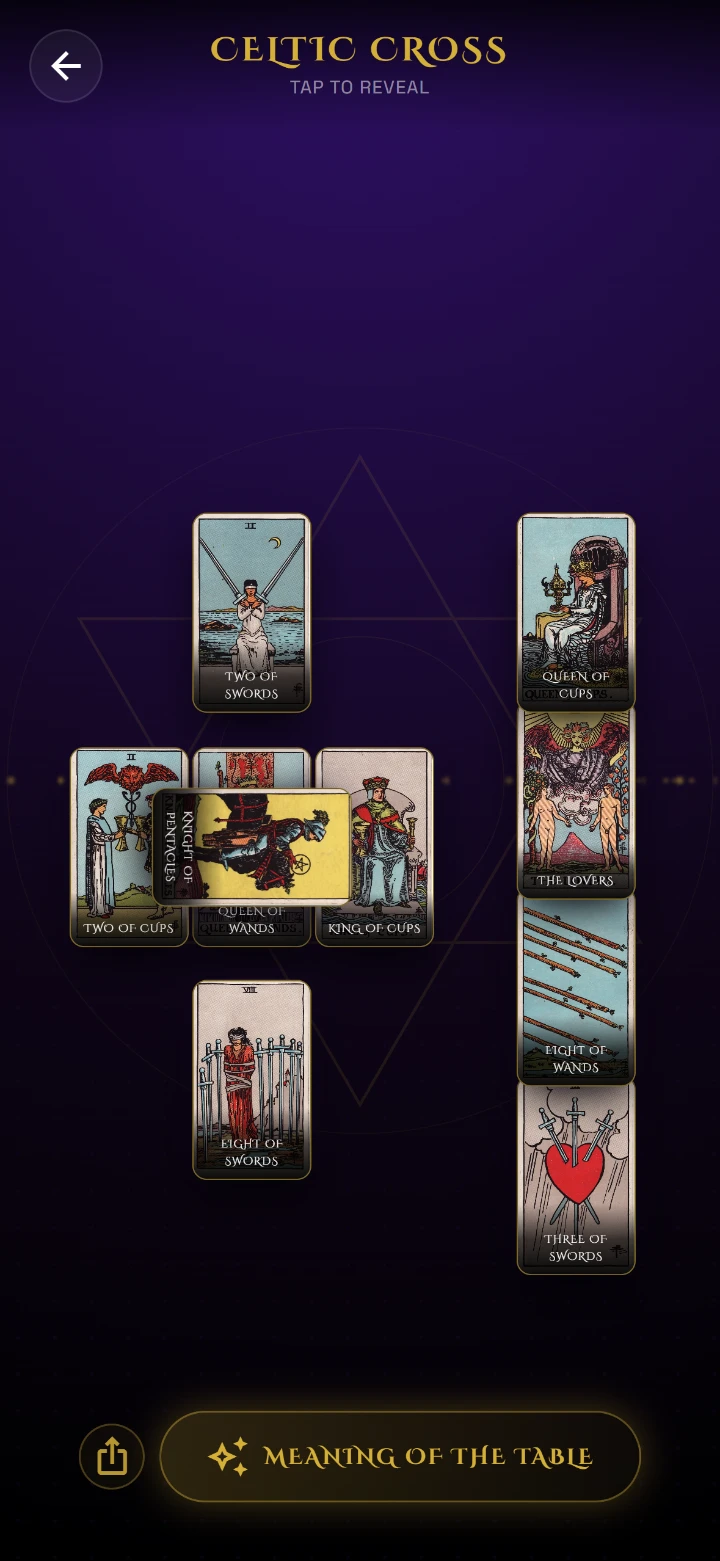
A tarot journal is useful when it helps you return to a reading with context. It does not need to be beautifully illustrated or several pages long. A small, consistent record can be easier to revisit than an elaborate entry you rarely finish.
Record the question and the positions
Start with the date, your question, the spread and the cards in their positions. Without the original question, a later reading of your notes can become a different interpretation altogether.
Separate observation from interpretation
Write what you noticed in the image, then what you thought it might mean. Keeping those two lines separate helps you see when an interpretation came from the artwork, a guide or your current situation.
Add one possible action
Choose a small action connected to the reflection, such as asking for clarification or giving yourself time to gather information. An action should make sense independently of the cards. You can also decide that no action is needed yet.
Return without forcing a match
When you revisit an entry, include the parts that did not fit your experience. A useful journal preserves uncertainty and changes of mind. It is not a scoreboard designed to prove every reading correct.
Use the journal inside Oraculum
The free journal holds up to ten readings; Premium expands the experience. Review a saved reading before pulling more cards. If you share a card publicly, check what the share template displays and keep personal questions private when appropriate.
A record that separates observation from interpretation
Start with the date, question and method. If the reading has positions, write their names and the symbols drawn in each. Then separate the record into three parts: what you observed in the image or text, the interpretation you made, and an action you chose to consider. This makes it easier to reread without confusing the random result with conclusions you added. For example, “the card shows a person walking” is an observation; “this relates to my wish for change” is a personal association. Neither needs to become “a change will happen”. Finish with an open question. A short entry with these distinctions is often easier to review than a story that mixes facts, wishes and expectations.
Review without remembering only what seemed to fit
Choose a later moment to return to the original entry and avoid rewriting it before reviewing. Add a new note describing what happened, what you expected and what did not match. If the interpretation was too broad to compare with any observation, record that too. The purpose is not to stage a contest of correct predictions between tools. It is to learn how you frame questions, interpret ambiguity and choose actions. Look for patterns in your reading habits: repeated questions, themes that make you hurry, or situations in which you seek confirmation. These may be more useful for your practice than counting how often a keyword seemed to match the day.
A manageable routine and care with your notes
You might reserve a few minutes for an entry and a weekly moment for review. Missing a day does not require several readings to compensate. The journal serves your attention, not an obligation. Avoid identifiable information about other people, especially if you intend to share a screenshot. Before publishing, check names, dates and details you do not want to make public. The application is designed to develop that continuity. Until launch, a personal file or paper notebook lets you try the recording format.
How often should I write?
Choose a rhythm you can sustain. One thoughtful entry and a later review can be more useful than a daily streak you rush through.
For reflection and entertainment. Readings do not guarantee outcomes or replace professional advice.