✦ TAROT · FOUR SUITS, MANY STORIES
The 56 Minor Arcanatarot in everyday life.
A conversation. An idea. A small act of care. Discover the cards that give shape to daily life and learn to connect suit, number, image and context.
01 / The basics
What are the Minor Arcana in tarot?
The Minor Arcana are the 56 tarot cards divided into four suits: Wands, Cups, Swords and Pentacles. Each suit has 14 cards: ten numbered cards, Ace through Ten, and four court cards — Page, Knight, Queen and King. Alongside the 22 Major Arcana, they form the 78-card tarot deck.
In symbolic readings, the Minor Arcana help explore actions, relationships, thoughts and material circumstances. “Minor” identifies a part of the deck, not a lower level of importance. Cards do not contain fixed time frames: a reading depends on the question, spread position and neighbouring cards.
Major and Minor Arcana: how they work together
| Group | Structure | In a reading |
|---|---|---|
| Major Arcana | 22 cards | A broad perspective on themes and change. |
| Minor Arcana | 56 cards · 4 suits | How a theme appears in a concrete situation. |
02 / Four suits
The four tarot suits and their elements
This guide uses elemental associations common in the Western esoteric tradition connected with Rider–Waite–Smith. They support study but are not universal across every school.
03 / RIDER–WAITE–SMITH
All 56 Minor Arcana cards and their meanings
Open a card to enlarge the Rider–Waite–Smith artwork and study its image, central meaning, practical context, challenges and a reflection question.
56 of 56 cards
Wands · Fire
Initiative · creativity · direction
Wands follows the will to act: beginning, competing, sustaining a project and recognising responsibilities. The same energy can inspire or push too fast.
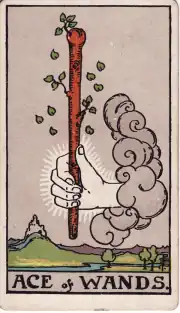
Ace · FireAce of Wands
A spark. The body’s yes to beginning.
Enlarge and explore ↗
Look at the image
A hand emerges from a cloud holding a budding wand above a landscape with a castle.
The central meaning
A spark. The body’s yes to beginning.
In practice
An energising idea, an invitation or enthusiasm for a project. A creative impulse that still needs a practical form.
Challenges and reversals
Enthusiasm gone by day two. Or a spark no one strikes.
A question to reflect on
What is asking for a small, hot start — not a five-year plan?
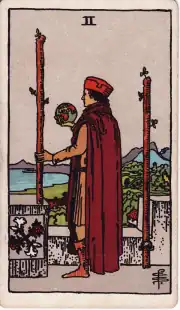 Two · Fire
Two of Wands
Looking at the horizon with what is already in hand.
Enlarge and explore ↗
Look at the image
A figure holds a globe and a wand, looking from a battlement; a second wand is fixed beside him.
The central meaning
Looking at the horizon with what is already in hand.
In practice
A choice of direction, a strategic partnership, staying or expanding. Compare possibilities without confusing planning with action.
Challenges and reversals
Planning without leaving. Or leaving without a map.
A question to reflect on
What next territory can I already see — without abandoning what I built?
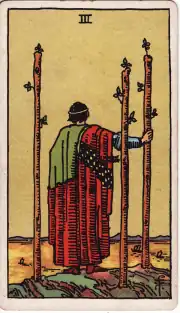 Three · Fire
Three of Wands
The ship has left. Wait for return with presence.
Enlarge and explore ↗
Look at the image
A figure seen from behind watches distant ships with three wands planted nearby.
The central meaning
The ship has left. Wait for return with presence.
In practice
A project launched, active waiting, collaboration at a distance, first signs the risk was sound.
Challenges and reversals
Calling the boat back too soon. Or leaving the dock and not tracking what you sent.
A question to reflect on
What have I already dispatched — that now wants company, not a restart?
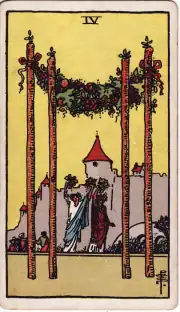 Four · Fire
Four of Wands
A marker. A temporary house in celebration.
Enlarge and explore ↗
Look at the image
Four wands support a garland; two figures raise flowers in front of a building.
The central meaning
A marker. A temporary house in celebration.
In practice
A gathering, an engagement, a move, a team that can finally breathe. A roof stable enough to toast.
Challenges and reversals
Party as escape. Or refusing any marker — living only in “not yet”.
A question to reflect on
What is already solid enough to recognise, even if the road continues?
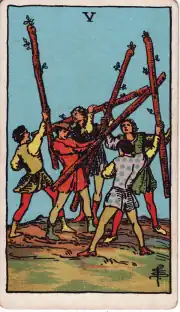 Five · Fire
Five of Wands
Clashing wills. A contest that can still be play.
Enlarge and explore ↗
Look at the image
Five figures raise wands in different directions in a scene of contest or exercise.
The central meaning
Clashing wills. A contest that can still be play.
In practice
Competition, a noisy meeting, ideas bumping into each other. Not always an enemy: sometimes too much heat in one room.
Challenges and reversals
Fighting for the sport. Or swallowing conflict until it becomes a Sword.
A question to reflect on
Is this friction sharpening the work — or only tiring everyone?
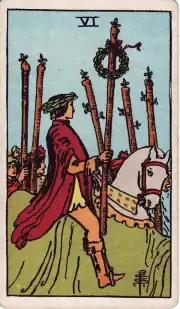 Six · Fire
Six of Wands
Visible recognition. Victory wants a witness.
Enlarge and explore ↗
Look at the image
A laurel-crowned rider appears among other people, with another wreath attached to his wand.
The central meaning
Visible recognition. Victory wants a witness.
In practice
Good feedback, a promotion, work that shows. Receive the applause without dissolving into it.
Challenges and reversals
Living only for the audience. Or refusing any recognition out of modesty.
A question to reflect on
Where does a result already ask to be seen — without becoming my whole name?
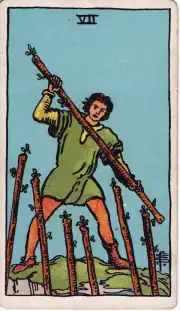 Seven · Fire
Seven of Wands
Ground won, now held.
Enlarge and explore ↗
Look at the image
A figure on higher ground faces six wands rising from below.
The central meaning
Ground won, now held.
In practice
Keeping what you built: a boundary, an argument, persistence. You are on the hill; someone tests the climb.
Challenges and reversals
Endless defence, never coming down to talk. Or giving the ground at the first push.
A question to reflect on
What is worth defending — and what am I defending only by habit?
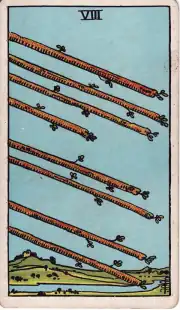 Eight · Fire
Eight of Wands
Messages and facts at speed.
Enlarge and explore ↗
Look at the image
Eight wands cross the sky over an open landscape, with no human figures.
The central meaning
Messages and facts at speed.
In practice
Rapid movement, messages and events following one another. Consider coordinating what is already underway while paying attention to context.
Challenges and reversals
Anxious acceleration. Or freezing everything because it is “not perfect yet”.
A question to reflect on
What is already in motion and only needs me not to over-handle it?
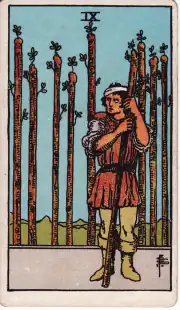 Nine · Fire
Nine of Wands
Tired alertness. Still standing.
Enlarge and explore ↗
Look at the image
A bandaged figure holds one wand in front of eight others standing in a row.
The central meaning
Tired alertness. Still standing.
In practice
Persistence after several rounds. A boundary, a watch, “I can hold a little more” — with the wounds showing.
Challenges and reversals
Suspecting everyone. Or quitting in the last stretch from sheer depletion.
A question to reflect on
What limit would keep me standing without turning me into a sentry all day?
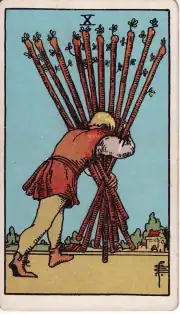 Ten · Fire
Ten of Wands
Too much load, even if the goal is near.
Enlarge and explore ↗
Look at the image
A bent figure carries ten wands toward a town.
The central meaning
Too much load, even if the goal is near.
In practice
Piled responsibilities, “I’ll handle it”, a project become a burden. Arrival exists — the way of carrying is the problem.
Challenges and reversals
Heroics that make you ill. Or dropping what still matters instead of sharing it.
A question to reflect on
What can I set down today without leaving the road?
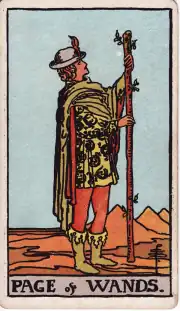 Page · Fire
Page of Wands
A message of fire. Curiosity that wants a trial.
Enlarge and explore ↗
Look at the image
A young figure studies a budding wand in a dry landscape.
The central meaning
A message of fire. Curiosity that wants a trial.
In practice
News of a project, an eager student, a raw idea. Good for a small test.
Challenges and reversals
Starting for the sake of starting. Promise without follow-through.
A question to reflect on
What simple experiment would honour this curiosity without demanding a destiny?
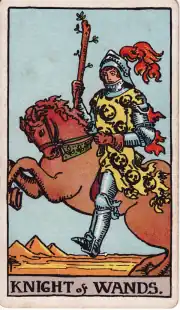 Knight · Fire
Knight of Wands
Departure. Wanting the road now.
Enlarge and explore ↗
Look at the image
A rider holds a wand on a rearing horse, with dry hills behind him.
The central meaning
Departure. Wanting the road now.
In practice
The impulse to travel, change, declare, launch. Visible courage. Also: heat that will not read the map.
Challenges and reversals
Impulse that burns a bridge. Or a desire that never leaves speech.
A question to reflect on
Where does this fire want to go — and what does it refuse to see on the way?
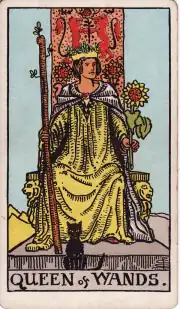 Queen · Fire
Queen of Wands
Warmth with a centre. Magnetism that does not ask permission.
Enlarge and explore ↗
Look at the image
A queen holds a wand and a sunflower, with a black cat in front of her throne.
The central meaning
Warmth with a centre. Magnetism that does not ask permission.
In practice
Creative presence, warm leadership, trust in one’s own light. Tending the fire without burning the house.
Challenges and reversals
Vanity, jealousy of the spotlight. Or dimming so as not to disturb.
A question to reflect on
How can I take up space with warmth — without scorching someone else’s?
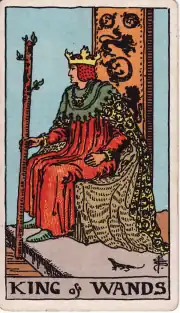 King · Fire
King of Wands
Vision that decides. Fire with a public direction.
Enlarge and explore ↗
Look at the image
A king holds a budding wand; lions and salamanders decorate the scene.
The central meaning
Vision that decides. Fire with a public direction.
In practice
Project leadership, founding, inspiring a group. Creative authority: not only having the idea, carrying the mission.
Challenges and reversals
Tyranny of “my vision”. Or refusing the role of the one who points the way.
A question to reflect on
What decision of direction is asking for someone who can hold the heat — and might that someone be me?
Cups · Water
Feelings · relationships · imagination
Cups explores emotional experience, exchange, joy, memory and loss. A Cups card can also appear in a work question: the context may concern relationships with colleagues.
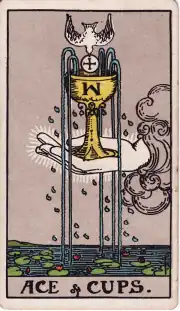 Ace · Water
Ace of Cups
A new spring. The heart opens.
Enlarge and explore ↗
Look at the image
A hand offers a cup with five streams of water flowing from it; a dove descends above it.
The central meaning
A new spring. The heart opens.
In practice
Feeling that begins, possible forgiveness, emotional creativity, an invitation to closeness. A cup not yet drunk.
Challenges and reversals
Idealising the feeling. Or capping the water the moment it appears.
A question to reflect on
What in me is ready to receive — without demanding a whole story yet?
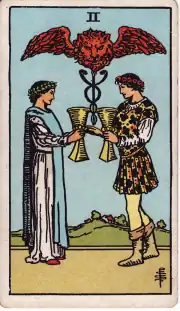
Two · WaterTwo of Cups
A reciprocal meeting.
Enlarge and explore ↗
Look at the image
Two figures offer cups to each other beneath a caduceus and a winged lion’s head.
The central meaning
A reciprocal meeting.
In practice
Partnership, repair, chemistry with respect. Not only romance: any “I see you, you see me”.
Challenges and reversals
Fusion that erases both. Or waiting for reciprocity from someone who cannot give it.
A question to reflect on
Where is (or could there be) a meeting of equals — not a rescue?
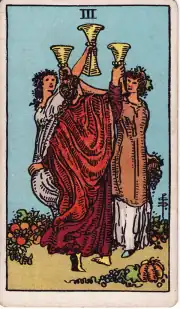 Three · Water
Three of Cups
Shared joy.
Enlarge and explore ↗
Look at the image
Three figures raise cups in a circle, with fruit and vegetation at their feet.
The central meaning
Shared joy.
In practice
Friendship, a small gathering, a support net, celebration among peers. The cup multiplies when it is passed.
Challenges and reversals
A party that avoids the hard talk. Or a solitude that refuses any circle.
A question to reflect on
With whom could I share a real joy — not only a social duty?
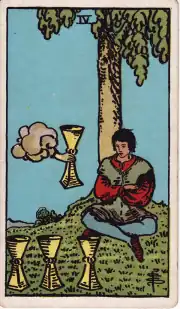 Four · Water
Four of Cups
An offer in front of you, a closed gaze.
Enlarge and explore ↗
Look at the image
A figure sits with folded arms beneath a tree; three cups stand on the ground and a hand offers a fourth.
The central meaning
An offer in front of you, a closed gaze.
In practice
Apathy, boredom, “this isn’t it”. Sometimes the withdrawal is needed. Sometimes the new cup is already being held out.
Challenges and reversals
Refusing by habit. Or numbing feeling until nothing arrives.
A question to reflect on
Am I truly resting — or refusing what did not arrive in the shape I ordered?
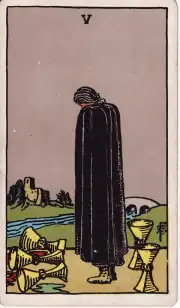 Five · Water
Five of Cups
The spill fills the view; two cups still stand.
Enlarge and explore ↗
Look at the image
A dark-cloaked figure looks at three spilled cups; two remain upright behind him, near a river and bridge.
The central meaning
The spill fills the view; two cups still stand.
In practice
Grief, disappointment, an ending. The pain is real. The card also shows what did not fall.
Challenges and reversals
Living only in the fallen cup. Or pretending nothing spilled.
A question to reflect on
What do I need to mourn fully — so I can turn toward what remains?
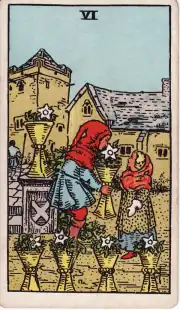 Six · Water
Six of Cups
A sweet memory. The past visits.
Enlarge and explore ↗
Look at the image
One figure offers another a cup of flowers in a courtyard with more flower-filled cups.
The central meaning
A sweet memory. The past visits.
In practice
Memory, childhood, generosity and old connections. Consider what the past offers the present without treating the card as a promise of reunion.
Challenges and reversals
Idealising “how it was”. Or cutting every root for fear of looking naive.
A question to reflect on
Which part of the past still feeds me — and which only stops me growing from here?
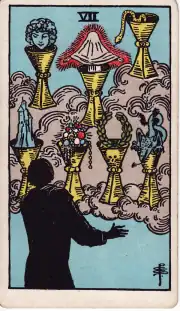 Seven · Water
Seven of Cups
Many cups, little ground.
Enlarge and explore ↗
Look at the image
A silhouette faces seven cups in clouds containing varied images, including jewels, a wreath and a snake.
The central meaning
Many cups, little ground.
In practice
Options, fantasy, stacked wishes. A rich imagination — and the risk of choosing none.
Challenges and reversals
Illusion, escape, infinite “what if”. Or killing every fantasy out of cynicism.
A question to reflect on
Which cup would I take with me if I could choose only one this week?
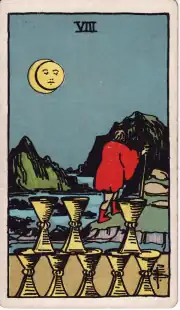 Eight · Water
Eight of Cups
Leaving what no longer feeds.
Enlarge and explore ↗
Look at the image
A figure with a staff walks away from eight cups beneath the moon toward mountainous ground.
The central meaning
Leaving what no longer feeds.
In practice
Walking away from a bond, a job, a habit that is emotionally empty — even if it is “not that bad”. A night road, a quiet decision.
Challenges and reversals
Fleeing anything that asks for depth. Or staying in a dry bond for fear of the road.
A question to reflect on
What do I already know has ended — and still visit out of habit?
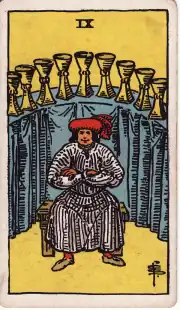 Nine · Water
Nine of Cups
A wish met. Visible contentment.
Enlarge and explore ↗
Look at the image
A seated figure folds his arms in front of nine cups arranged in an arc.
The central meaning
A wish met. Visible contentment.
In practice
Pleasure, hospitality, “it worked”. Too good to be only vanity: also the right to be well.
Challenges and reversals
Complacency, consumption as affection. Or guilt for being satisfied.
A question to reflect on
Can I recognise what is already good — without making it the only measure of a life?
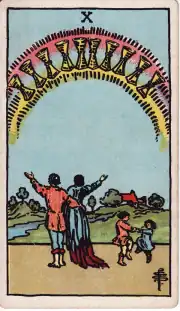 Ten · Water
Ten of Cups
An affective home in harmony.
Enlarge and explore ↗
Look at the image
Two figures raise their arms beneath a rainbow of ten cups while children play nearby.
The central meaning
An affective home in harmony.
In practice
Family (chosen or given), belonging, domestic peace. The emotional cycle closes in communion — not in perfection.
Challenges and reversals
The happy family as a demand. Or refusing any root.
A question to reflect on
What kind of belonging do I want to grow — the portrait, or the real living-together?
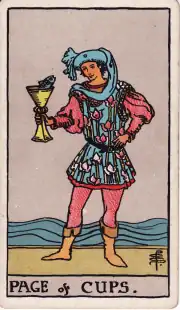 Page · Water
Page of Cups
A message of water. Feeling as a student.
Enlarge and explore ↗
Look at the image
A young figure holds a cup with a fish emerging from it, with water in the background.
The central meaning
A message of water. Feeling as a student.
In practice
An affectionate invitation, a dream, a first apology, the start of art. The heart is still learning its language.
Challenges and reversals
Thin skin, a crush on everything. Or shame at feeling.
A question to reflect on
Which small feeling deserves to be heard without becoming a decision yet?
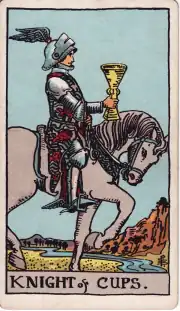 Knight · Water
Knight of Cups
An offer on the move. The romance of the road.
Enlarge and explore ↗
Look at the image
A rider presents a cup on a horse walking beside a watercourse.
The central meaning
An offer on the move. The romance of the road.
In practice
A declaration, a proposed repair, a poetic gesture, a search for meaning. Also: a beautiful promise that still needs ground.
Challenges and reversals
Enchantment that never arrives. Or cynicism that refuses any gesture.
A question to reflect on
Is this offer a path — or only a beautiful picture of the path?
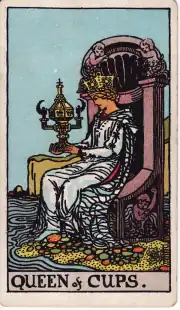 Queen · Water
Queen of Cups
Deep listening. Water held in the cup.
Enlarge and explore ↗
Look at the image
A queen studies an ornate, covered cup while seated beside the water.
The central meaning
Deep listening. Water held in the cup.
In practice
Empathy, imagination and attention to emotional experience. Careful listening includes respecting your limits and checking impressions before treating them as facts.
Challenges and reversals
Absorbing everyone’s pain. Or closing so tight that no one reaches you.
A question to reflect on
Where can I welcome — without leaving the rim of my own cup?
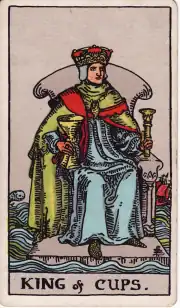 King · Water
King of Cups
Feeling with governance. Calm that steadies the boat.
Enlarge and explore ↗
Look at the image
A king holds a cup and sceptre on a throne surrounded by water, with a ship and fish in the background.
The central meaning
Feeling with governance. Calm that steadies the boat.
In practice
Mediation, counsel, mature feeling in a role of responsibility. To feel and still decide.
Challenges and reversals
Coldness dressed as control. Or a mood that bursts because it was dammed.
A question to reflect on
Which decision asks me to feel all of it — and still choose with clarity?
Swords · Air
Thought · language · decisions
Swords concerns discernment, communication, tension and choices. Not every Sword is a conflict: the Ace can suggest clarity and the Four a pause.
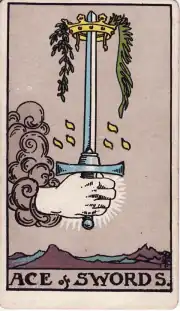
Ace · AirAce of Swords
A clean blade. An idea that parts the mist.
Enlarge and explore ↗
Look at the image
A hand emerges from a cloud holding an upright crowned sword, with branches hanging from the crown.
The central meaning
A clean blade. An idea that parts the mist.
In practice
Sudden clarity, a truth spoken, an intellectual decision, an honest start. Air comes in.
Challenges and reversals
Being right as a weapon. Or avoiding the sentence that needs saying.
A question to reflect on
Which simple truth, if I named it, would already change the air here?
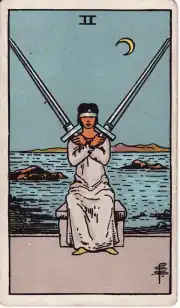 Two · Air
Two of Swords
A blindfold, two blades at rest.
Enlarge and explore ↗
Look at the image
A blindfolded figure crosses two swords before her chest, with water and a crescent moon behind her.
The central meaning
A blindfold, two blades at rest.
In practice
Indecision, a tense truce or a need to suspend judgement. Ask what information is missing and what would make a choice clearer.
Challenges and reversals
Endless neutrality. Or choosing in the dark just to end the discomfort.
A question to reflect on
What would I need to take from in front of my eyes for a choice to exist?
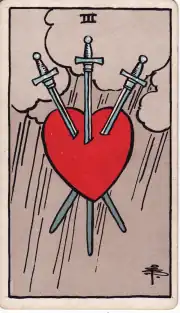 Three · Air
Three of Swords
Named pain. The cut in the chest.
Enlarge and explore ↗
Look at the image
Three swords pierce a suspended heart beneath clouds and rain.
The central meaning
Named pain. The cut in the chest.
In practice
Hurt, hard news, a split, a truth that hurts because it is true. Not drama: the cost of clarity.
Challenges and reversals
Turning the blade over and over. Or denying the wound until it becomes another suit.
A question to reflect on
Which pain needs to be recognised out loud — so it stops repeating in silence?
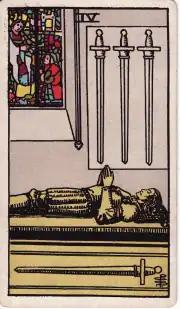 Four · Air
Four of Swords
The mind withdrawn. A truce.
Enlarge and explore ↗
Look at the image
A carved figure rests on a tomb, with three swords on the wall and one along the side beneath a stained-glass window.
The central meaning
The mind withdrawn. A truce.
In practice
Pause after conflict, rest, deliberate silence, recovery. The sword is on the tomb — not in the hand.
Challenges and reversals
Isolating forever. Or refusing any pause and breaking.
A question to reflect on
What mental noise do I need to leave so the next decision is not made wounded?
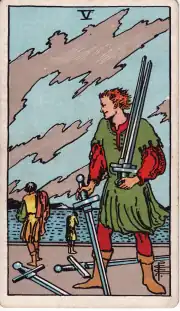 Five · Air
Five of Swords
A win that leaves the field empty.
Enlarge and explore ↗
Look at the image
One figure gathers swords while two others walk away near the water.
The central meaning
A win that leaves the field empty.
In practice
A dispute in which winning may cost trust or connection. One figure gathers the swords while the others walk away; consider the context and the cost of conflict.
Challenges and reversals
Competing in every conversation. Or always yielding so as not to be the one who takes the weapons.
A question to reflect on
If I win this way, what remains of the relationship — and do I still want that?
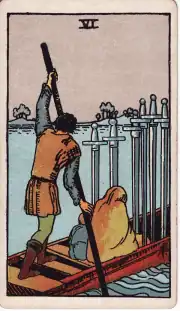 Six · Air
Six of Swords
Crossing. Leaving rough water.
Enlarge and explore ↗
Look at the image
A person poles a boat carrying two passengers and six swords.
The central meaning
Crossing. Leaving rough water.
In practice
Transition, distance from conflict or help through a difficult period. Consider the crossing and the resources accompanying you.
Challenges and reversals
Fleeing without crossing. Or refusing the help of the one who rows.
A question to reflect on
Which small crossing would already take me out of this stretch — without solving a whole life?
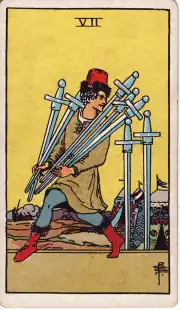 Seven · Air
Seven of Swords
Strategy in shadow. Taking what will fit.
Enlarge and explore ↗
Look at the image
A figure carries five swords while looking back; two remain planted near a camp.
The central meaning
Strategy in shadow. Taking what will fit.
In practice
Strategy, discretion or an attempt to resolve something without confrontation; in some contexts, omission or evasion. The card alone does not establish lying or betrayal.
Challenges and reversals
Lying as a method. Or naive transparency on ground that needs tact.
A question to reflect on
Am I being discreet out of wisdom — or hiding what I need to own?
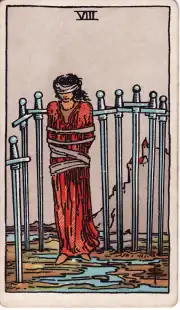 Eight · Air
Eight of Swords
Restriction and difficulty seeing alternatives.
Enlarge and explore ↗
Look at the image
A figure stands blindfolded and bound among eight swords, with wet ground underfoot and a building behind her.
The central meaning
Restriction and difficulty seeing alternatives.
In practice
The image can represent limits, helplessness or incomplete information. Distinguish practical obstacles from assumptions and consider helpful support. Not every difficulty is created by the mind.
Challenges and reversals
Treating a limitation as permanent without examining it, or denying real barriers by demanding positive thinking alone.
A question to reflect on
Which limitation could I examine safely, and what support would expand my options?
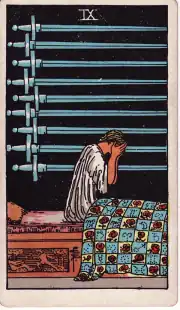 Nine · Air
Nine of Swords
The mind at night. Worry that will not lie down.
Enlarge and explore ↗
Look at the image
A figure sits in bed covering their face, with nine swords aligned on a dark wall.
The central meaning
The mind at night. Worry that will not lie down.
In practice
Worry, guilt and recurring thoughts are possible themes for reflection. The image cannot measure a problem’s severity or diagnose anyone’s mental health.
Challenges and reversals
Feeding the rehearsal. Or being ashamed of suffering and suffering alone.
A question to reflect on
Which worry asks for a concrete gesture in the morning — and which only asks for light and company now?
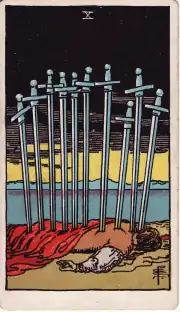 Ten · Air
Ten of Swords
A painful ending and the possibility of another stage.
Enlarge and explore ↗
Look at the image
A fallen figure has ten swords in their back, with a band of light on the horizon.
The central meaning
A painful ending and the possibility of another stage.
In practice
Explore the feeling that a situation or story has run its course. Light on the horizon contrasts with the scene. This is neither a prediction of physical death nor a guarantee of immediate improvement.
Challenges and reversals
Identifying with the bottom. Or refusing the end and replaying the last scene.
A question to reflect on
What has already died in this story — and what dawn begins if I stop reliving the last frame?
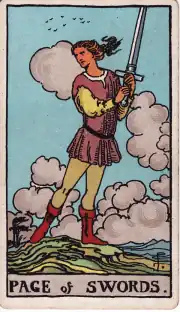 Page · Air
Page of Swords
A message of air. A sharp question, a student mind.
Enlarge and explore ↗
Look at the image
A young figure holds an upright sword and looks sideways beneath moving clouds.
The central meaning
A message of air. A sharp question, a student mind.
In practice
News, study, critical curiosity, an inner child who asks. Good for investigating. Poor for accusing early.
Challenges and reversals
Gossip, early cynicism. Or fear of asking.
A question to reflect on
Which honest question have I not asked — for fear of the answer, or of seeming rude?
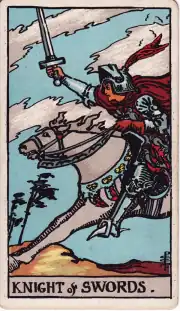 Knight · Air
Knight of Swords
The mind at a gallop.
Enlarge and explore ↗
Look at the image
A rider charges with a raised sword as the horse gallops and trees bend.
The central meaning
The mind at a gallop.
In practice
Debate, a deadline, an argument that advances. Fast intelligence. Also: speech that runs people over.
Challenges and reversals
Verbal aggression. Or a brilliant idea that never enters the right fight.
A question to reflect on
Is this speed in service of truth — or only of arriving first?
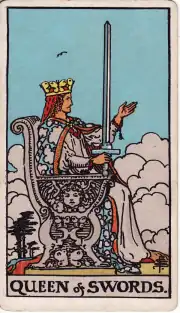 Queen · Air
Queen of Swords
Discernment, independence and clear boundaries.
Enlarge and explore ↗
Look at the image
A queen holds a sword upright in one hand and extends the other with an open palm.
The central meaning
Discernment, independence and clear boundaries.
In practice
Discernment, independence, direct talk, a clean boundary. Done with excess: she has already cut what needed cutting.
Challenges and reversals
Coldness that isolates. Or swallowing the sentence in order to “be good”.
A question to reflect on
Which boundary can I say whole — without having to justify it with anger?
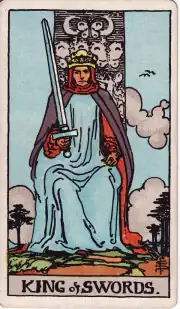 King · Air
King of Swords
Public criterion. The law of the situation.
Enlarge and explore ↗
Look at the image
A king faces forward holding a raised sword; his throne bears butterfly motifs.
The central meaning
Public criterion. The law of the situation.
In practice
An ethical decision, analysis, leadership by reason, fair mediation. Thinking for the group, not only for a preference.
Challenges and reversals
Intellectual authoritarianism. Or refusing to judge what asks for judgement.
A question to reflect on
Which fair criterion — not only my taste — should govern this decision?
Pentacles · Earth
Resources · time · craft
Pentacles, also called Coins or Disks, explores resources, work, learning and support. The material field includes time and practical care as well as money.
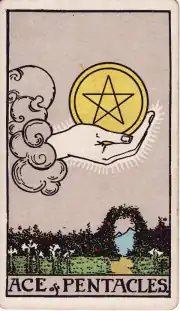 Ace · Earth
Ace of Pentacles
A seed in soil. A concrete chance.
Enlarge and explore ↗
Look at the image
A hand offers a pentacle above a garden with a leafy arch opening toward mountains.
The central meaning
A seed in soil. A concrete chance.
In practice
A real offer, a first payment, a chance to study, a body that starts again. Still a seed — but earth, not idea.
Challenges and reversals
Wanting harvest in the week of planting. Or leaving the seed on the table, with no soil.
A question to reflect on
Which small, real opportunity can I plant this week?
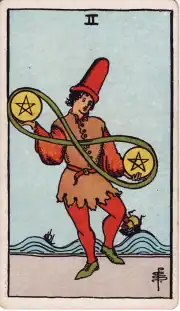 Two · Earth
Two of Pentacles
Juggling. Two weights, one rhythm.
Enlarge and explore ↗
Look at the image
A figure juggles two pentacles linked by an infinity-shaped loop, with ships riding waves behind him.
The central meaning
Juggling. Two weights, one rhythm.
In practice
Bills, a calendar, holding two roles. Flexibility. Life fits if the body dances — not if it stiffens.
Challenges and reversals
Saying yes to everything until the fall. Or freezing because “it can’t be balanced”.
A question to reflect on
What needs to leave the rotation so what matters can stay standing?
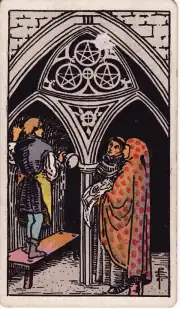 Three · Earth
Three of Pentacles
Shared craft. The work has more than one hand.
Enlarge and explore ↗
Look at the image
A craftsperson works on a building while two others consult a drawing; three pentacles decorate the arch.
The central meaning
Shared craft. The work has more than one hand.
In practice
A team, learning from someone further on, well-made work that shows. Visible quality.
Challenges and reversals
Doing it alone out of pride. Or handing everything over without a standard.
A question to reflect on
Who should be in this work with me — and what do I still refuse to learn from another hand?
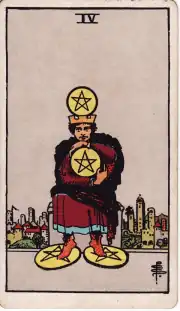 Four · Earth
Four of Pentacles
Holding. Keeping what cost something.
Enlarge and explore ↗
Look at the image
A seated figure holds one pentacle, rests their feet on two and has a fourth above their head.
The central meaning
Holding. Keeping what cost something.
In practice
Saving, a limit, protecting a resource. Also: closing, fear of spending affection, time, or money.
Challenges and reversals
Miserliness, control. Or spending everything so as not to seem attached.
A question to reflect on
Am I keeping in order to sustain a life — or so I will not feel that life moves?
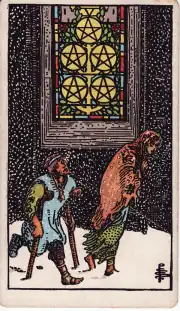 Five · Earth
Five of Pentacles
Outside in the cold. Visible lack.
Enlarge and explore ↗
Look at the image
Two figures walk through snow outside a lit window with five pentacles; one uses crutches.
The central meaning
Outside in the cold. Visible lack.
In practice
Scarcity, exclusion or difficulty accessing support are symbolic themes of the card. Consider practical needs and available resources. The scene does not diagnose illness or predict financial losses.
Challenges and reversals
Shame about needing help, difficulty finding it or feeling that scarcity defines the whole experience.
A question to reflect on
What support actually exists, and what first step could help me access it?
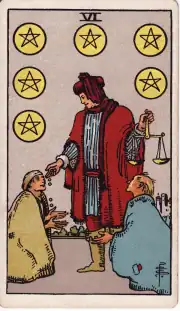 Six · Earth
Six of Pentacles
Fair circulation. Giving and receiving with measure.
Enlarge and explore ↗
Look at the image
A figure holds scales and gives coins to two kneeling people.
The central meaning
Fair circulation. Giving and receiving with measure.
In practice
Payment, generosity, mentorship, the balance between who has and who needs. The scales are in the picture for a reason.
Challenges and reversals
Help that creates control, unclear conditions or unequal power. Receiving support does not require repayment beyond your means.
A question to reflect on
In this situation am I the one who gives, the one who receives — and is the exchange honest?
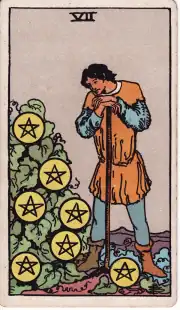 Seven · Earth
Seven of Pentacles
Stopping in the field to take stock.
Enlarge and explore ↗
Look at the image
A figure leans on a tool and studies a plant bearing pentacles.
The central meaning
Stopping in the field to take stock.
In practice
Patience with a slow process, reviewing an investment of time, money, or study. The fruit is not ripe — the work already exists.
Challenges and reversals
Quitting on the eve. Or waiting passively without adjusting the crop.
A question to reflect on
What has my effort already shown — and what would ask for an adjustment, not an abandonment?
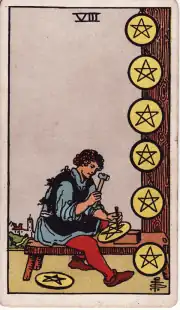 Eight · Earth
Eight of Pentacles
The bench. Repeating until it is well made.
Enlarge and explore ↗
Look at the image
A person works on a pentacle at a bench, with other finished pieces aligned nearby.
The central meaning
The bench. Repeating until it is well made.
In practice
Study, a craft, daily practice, specialising. Little glory, a lot of hand.
Challenges and reversals
Perfectionism that never delivers. Or mechanical work with no soul.
A question to reflect on
Which skill would grow if I gave it an honest hour, repeated, with no audience?
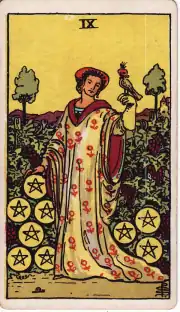
Nine · EarthNine of Pentacles
Quiet sovereignty. The garden you grew.
Enlarge and explore ↗
Look at the image
A figure stands in a vineyard with nine pentacles and holds a bird on a gloved hand.
The central meaning
Quiet sovereignty. The garden you grew.
In practice
Material autonomy, pleasure in what is yours, a tended body, work that already fruits. Alone in the orchard — by choice, not abandonment.
Challenges and reversals
Elegant isolation. Or dependence dressed as refinement.
A question to reflect on
What in my life is already fruit of my cultivation — that I still treat as provisional?
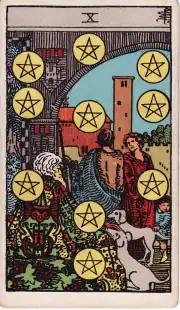 Ten · Earth
Ten of Pentacles
Lineage. The concrete that outlasts one person.
Enlarge and explore ↗
Look at the image
An older person, adults, a child and dogs appear near an arch, with ten pentacles arranged over the scene.
The central meaning
Lineage. The concrete that outlasts one person.
In practice
Family, inheritance, a house, a firm, a material tradition. Security shared across generations — of blood or of choice.
Challenges and reversals
Status as a cage. Or refusing any common root.
A question to reflect on
What structure do I want to leave (or inhabit) that would serve someone besides me?
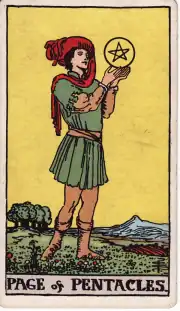 Page · Earth
Page of Pentacles
A message of earth. A student of the concrete.
Enlarge and explore ↗
Look at the image
A young figure raises and studies a pentacle in an open field.
The central meaning
A message of earth. A student of the concrete.
In practice
The start of a course, a practical offer, curiosity about a craft, a body that wants a new routine. Hands first, theory later.
Challenges and reversals
Collecting courses without practice. Or believing only the diploma counts.
A question to reflect on
What small, tactile learning can I begin without waiting for a perfect set-up?
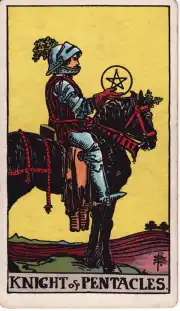 Knight · Earth
Knight of Pentacles
A steady step. The horse does not gallop — it crosses.
Enlarge and explore ↗
Look at the image
A rider holds a pentacle on a stationary horse in front of cultivated land.
The central meaning
A steady step. The horse does not gallop — it crosses.
In practice
Constancy, a deadline kept, work without drama. Reliable. Slow to anyone who wants fire.
Challenges and reversals
Rigidity, boredom. Or refusing the step-by-step because it “isn’t inspiring”.
A question to reflect on
What would move if I accepted the pace of earth — one square of ground at a time?
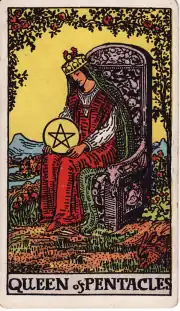 Queen · Earth
Queen of Pentacles
Care that sustains. Fertile earth with a keeper.
Enlarge and explore ↗
Look at the image
A queen studies a pentacle in her lap amid vegetation, with a rabbit on the ground.
The central meaning
Care that sustains. Fertile earth with a keeper.
In practice
A liveable house, a nourished body, a resource well run, practical hospitality. Abundance you can touch.
Challenges and reversals
Caring for everyone until your own resources run out, or clinging to comfort and resisting needed adjustments.
A question to reflect on
What — in house, body, or work — would grow if I nourished it with regularity, not guilt?
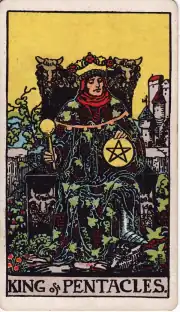 King · Earth
King of Pentacles
Visible stewardship. Earth with government.
Enlarge and explore ↗
Look at the image
A king holds a sceptre and pentacle on a bull-decorated throne surrounded by vines.
The central meaning
Visible stewardship. Earth with government.
In practice
Providing in the good sense: a stable endeavour, a mature money decision, concrete protection of a group. Wealth as responsibility.
Challenges and reversals
Control through money. Or refusing material growth for fear of corruption.
A question to reflect on
Which practical decision, taken responsibly, would sustain more than one life — including mine?
No cards match this combination. Clear the filters or try another term.
Art by Pamela Colman Smith · Rider–Waite–Smith · References
04 / Numbers & courts
Ace to Ten: a guide to remembering meanings
Use numbers as clues, not as a formula that replaces the scene. Compare the same number across suits and notice what changes.
- AcePotential, an offering, a beginning.
- TwoRelationship, polarity, choice.
- ThreeDevelopment and connection; in Swords, the scene emphasises pain.
- FourStructure, stability or a pause.
- FiveFriction, challenge or disrupted stability.
- SixExchange, memory, passage or recognition.
- SevenAssessment, defence, possibilities and strategy.
- EightDifferent themes: movement, departure, restriction or practice.
- NineAccumulated experience: satisfaction, independence, vigilance or worry.
- TenCulmination: fulfilment, continuity, overload or an ending.
The Eight of Wands shows speed; the Eight of Pentacles repeated work; the Eight of Swords restriction; and the Eight of Cups departure. Calling all four “discipline” would erase important differences in the images.
The 16 court cards: people, roles and attitudes
Each suit has four court cards. They may represent people, ways of acting or aspects of a situation. These associations are a contemporary study aid; gender, age, appearance and social position are not fixed rules for identifying someone.
Page
Curiosity, learning and first experiences: the attitude of an investigator.
Knight
Pursuit and movement. Compare the charging Knight of Swords with the stationary horse of the Knight of Pentacles.
Queen
Maturity and a cultivated relationship with the suit. Observe how each queen holds her symbol.
King
Responsibility, direction and stewardship: the role of someone accountable for choices.
Respecting tradition: image, source and interpretation
These scenes belong to Rider–Waite–Smith, illustrated by Pamela Colman Smith and published in 1909 under A. E. Waite’s direction. In the Tarot de Marseille, numbered cards generally show arrangements of suit symbols instead of these same scenes. Its methods work with forms, numbers and relationships; meanings should not all be transferred automatically.
For example, the Seven of Swords is often reduced to “deception” today. Waite also recorded plans, attempts, hope and a plan’s possible failure, acknowledging divergent readings. Studying the source expands the card instead of fixing it to an accusation.
Read Waite’s entry on the Seven of Swords ↗05 / How to read
How to interpret the Minor Arcana in a spread
Ask an open question and define the positions before revealing the cards. Then connect the meanings with a concrete context.
Observe the scene
Describe a gesture, an object and a relationship between figures before looking up a meaning.
Identify the suit’s field
Wands may highlight initiative; Cups relationships; Swords communication; Pentacles resources. Keep the question rather than forcing it to fit a keyword.
Compare number or rank with the image
A Page can suggest an apprentice’s attitude. A Five may recall friction, but check whether the scene shows competition, loss, conflict or exclusion.
Connect and record
Write a sentence for each position, an uncertainty and a possible action. When you revisit the reading, record what did not match your experience too.
Reversed cards and repeated suits
Reading reversals is a choice of method. These notes use “challenges” to explore excess, blockage or difficulty without reproducing Waite’s reversal lists literally. Repetition can help compare themes but also depends on the draw and spread composition. Several Cups do not cancel a work question or establish another person’s feelings.
Frequently asked questions about the Minor Arcana
How many Minor Arcana cards are there?
There are 56: four suits with 14 cards each. They comprise 40 numbered cards, Ace through Ten in each suit, and 16 court cards. Together with the 22 Major Arcana, they make 78 cards.
What are the four tarot suits?
Wands, Cups, Swords and Pentacles. In this Rider–Waite–Smith guide, their associations are Fire, Water, Air and Earth respectively. Pentacles may also be called Coins or Disks.
Are Pages and Knights the same card?
No. Each suit contains four court cards: Page, Knight, Queen and King. Page may be named Knave in some decks, Pajem or Valete in Portuguese, and Sota in Spanish. Check the titles in your deck.
Can I study the Minor Arcana on their own?
Yes. Start with one suit and compare the scenes from Ace to King. A short spread can serve as an exercise. Then mix the suits and explore how they relate to the Majors.
Are Swords always negative?
No. The suit includes discernment, decisions and communication as well as conflict. The Ace can suggest clarity, the Four a pause and the Six a transition. Position and question help shape the interpretation.
Is a 52-card playing deck the same as a 78-card tarot deck?
No. A standard 52-card playing deck has 13 cards per suit and lacks the 22 Major Arcana and the same four-court-card structure. It has its own cartomancy practices.
Do I need to memorise all 56 meanings?
No. Study suit, image and context. Use numbers as an aid and keep a journal. Individual scenes contain information that a numerical formula alone does not preserve.
References and editorial notes
An editorial adaptation of the three Minor Arcana guides provided to Oraculum, with revised scene descriptions and generalisations. Applications and questions are contemporary educational prompts. There is no single list of meanings shared by every tradition.
- A. E. Waite · The Pictorial Key to the Tarot: The Lesser Arcana (1910) ↗
- A history of tarot cards · Victoria and Albert Museum ↗
- Rider–Waite–Smith images · Wikimedia Commons ↗
Classic illustrations by Pamela Colman Smith under the direction of A. E. Waite, for the deck published in 1909. Images are derived from the Rider–Waite–Smith files already used in the Oraculum project.
Educational content for reflection and entertainment. Readings do not guarantee outcomes or replace professional advice.
ORACULUM
From symbols to your everyday life.
Keep studying the cards, shape your questions and discover Oraculum’s journal and Grimoire.
Discover Oraculum ↗