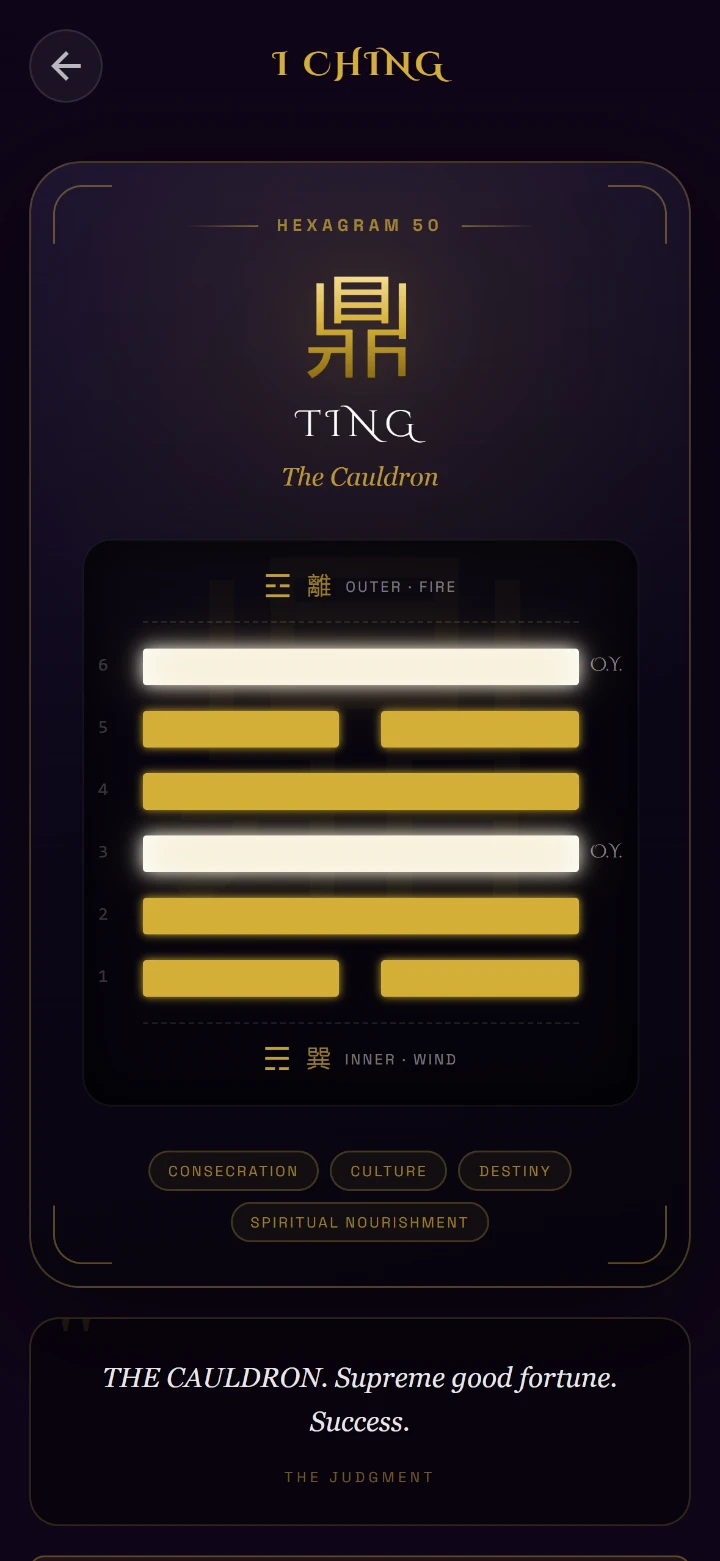
The I Ching, or Book of Changes, is a Chinese classic with a long history of interpretation and commentary. A consultation begins with a question and produces a six-line figure called a hexagram. The three-coin method is one way to construct it.
Write a question about the situation
A question such as “What should I understand about this transition?” invites attention to circumstances and change. Write it down before casting. Avoid treating the result as a substitute for information you can verify directly.
Cast six times, from bottom to top
In a common convention, assign heads a value of three and tails a value of two. Toss three coins and add the values. Repeat six times, recording the first line at the bottom and building upward. Keep the same convention throughout.
Read the four possible totals
Six is a changing broken line; seven is a stable solid line; eight is a stable broken line; nine is a changing solid line. The six recorded lines form the initial hexagram. Changing lines become their opposites in the relating hexagram.
Read the text in context
Consult the initial hexagram and the relevant changing-line passages in the translation you are using. Traditions differ in how they prioritize multiple changing lines. Keep track of the method rather than combining rules without noticing.
Explore the process in Oraculum
The app provides coin casting and hexagram interpretation. Watch the lines build and use the text as a prompt for reflection. Additional interpretation layers are part of Premium. A consultation does not guarantee future events.
Record the six lines in the correct order
In the three-coin method, assign values before starting and keep the convention throughout. With heads worth 3 and tails worth 2, each cast totals 6, 7, 8 or 9. The first cast forms the bottom line and the sixth forms the top. A 7 is stable yang and an 8 is stable yin. A 6 is changing yin and a 9 is changing yang. Recording only whether a line is solid or broken loses the information carried by changing values. If you draw the lines on paper, number them from bottom to top and keep the six totals alongside the drawing. This makes it possible to check the figure without relying on memory.
The initial hexagram, changing lines and related figure
The initial hexagram organizes the first reading of a situation. When changing lines are present, they receive attention within your chosen interpretive method. Changing a moving yin into yang and a moving yang into yin produces another figure, often called the relating or resulting hexagram. It need not be treated as a compulsory prediction of a future state. It can describe a relationship or a possibility for change to consider. Different conventions address readings with several changing lines; choose a source that explains its approach instead of mixing rules because one produces a more convenient answer. Without changing lines, the related figure is identical to the initial one. Do not invent a transformation that the cast did not produce.
Read the text without making every phrase an instruction
The language of a translation may be old-fashioned, concise or full of images that do not literally match your situation. Read the context supplied by the translator and identify the question the passage raises before applying a phrase to daily life. A passage about advancing, waiting or crossing does not decide a career change or a difficult conversation by itself. Ask which conditions need attention and what information is still missing. Record the edition you consulted: translations and commentaries can organize their explanations differently. This blog introduces the method for study; the complete consultation and its interpretive layers belong to the Oraculum app.
Are three coins the only way to consult the I Ching?
No. Other methods exist, including yarrow-stalk methods. Their procedures and probabilities can differ.
Historical reference: The Classic of Changes · Columbia University Press
For reflection and entertainment. Readings do not guarantee outcomes or replace professional advice.